Con el 43% de participación ciudadana, según el Servicio Electoral de Chile (Servel), la convocatoria para las elecciones no tuvo una participación alta, pero sí suficiente para comenzar a configurar un nuevo mapa político en el país. Sin duda, uno de los hitos que movilizó a gran parte de la población para acudir a las urnas, fue la votación para la elección de los integrantes de la Convención Constitucional, el organismo que desde junio tendrá la misión de redactar una nueva Constitución para Chile.
El órgano, cuya composición es de 155 miembros, eligió 88 candidatos independientes, es decir el 64% de los escaños del total de la Convención Constitucional. Además, dejando de lado los 17 cupos reservados para los pueblos originarios, sólo 50 constituyentes elegidos militan en algún partido político, es decir menos de un tercio. Esto demuestra el gran triunfo de los independientes en las últimas votaciones.
Un dato importante, y que tal vez releva el gran éxito de los independientes en este proceso, es la fuerte crisis de representatividad que sufren los partidos políticos. De acuerdo a la última encuesta CEP -publicada el pasado 29 de abril-, sólo el 2% de los chilenos confía en alguna de las coaliciones que han gobernado los últimos años Chile (los conglomerados de Michelle Bachelet y Sebastián Piñera), cuestionados por su incapacidad de presentar nuevas figuras políticas.
Respecto de las elecciones a Gobernadores, sólo fueron tres candidatos los que lograron imponerse en el cargo, tras conseguir el 40% de los votos, quedando las regiones de Valparaíso, Aysén y Magallanes con una autoridad electa. Los ganadores de las regiones restantes -en total 13- no se conocerán hasta el 13 de junio, la fecha fijada para la segunda vuelta electoral. Por otro lado, las elecciones municipales (alcaldes y concejales) tampoco permitieron actos de triunfalismo, ya que los candidatos de los partidos políticos recibieron un fuerte castigo, en especial los de la coalición de derecha. La tendencia fue que postulantes, en general desconocidos, pero con un fuerte compromiso ciudadano, pudieron catapultarse al poder.
A continuación, les presentamos algunas tendencias y data relevantes generados a partir de las elecciones.
Convención Constituyente
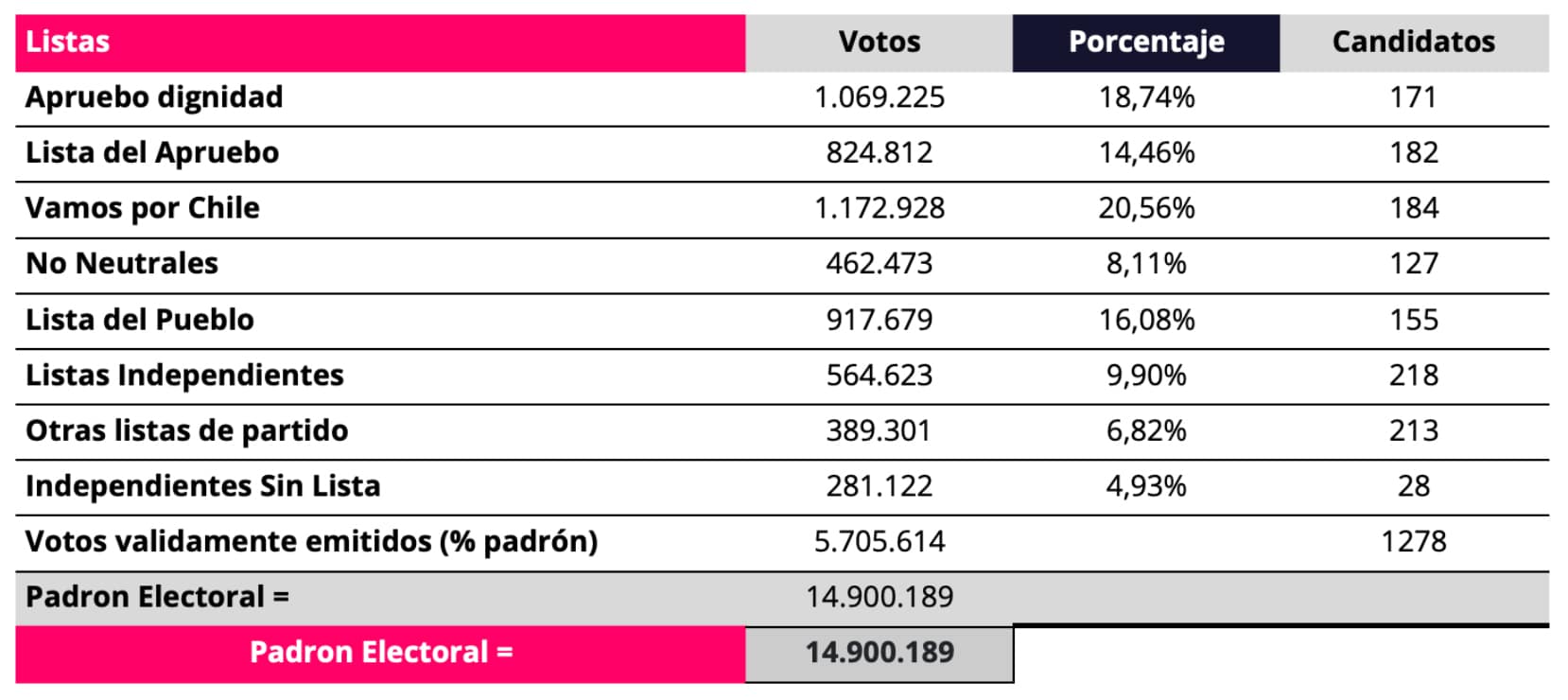
a) Resultados generales por lista
Los independientes y los rostros nuevos en el mundo de la política se convirtieron en la primera fuerza de la Convención Constitucional.
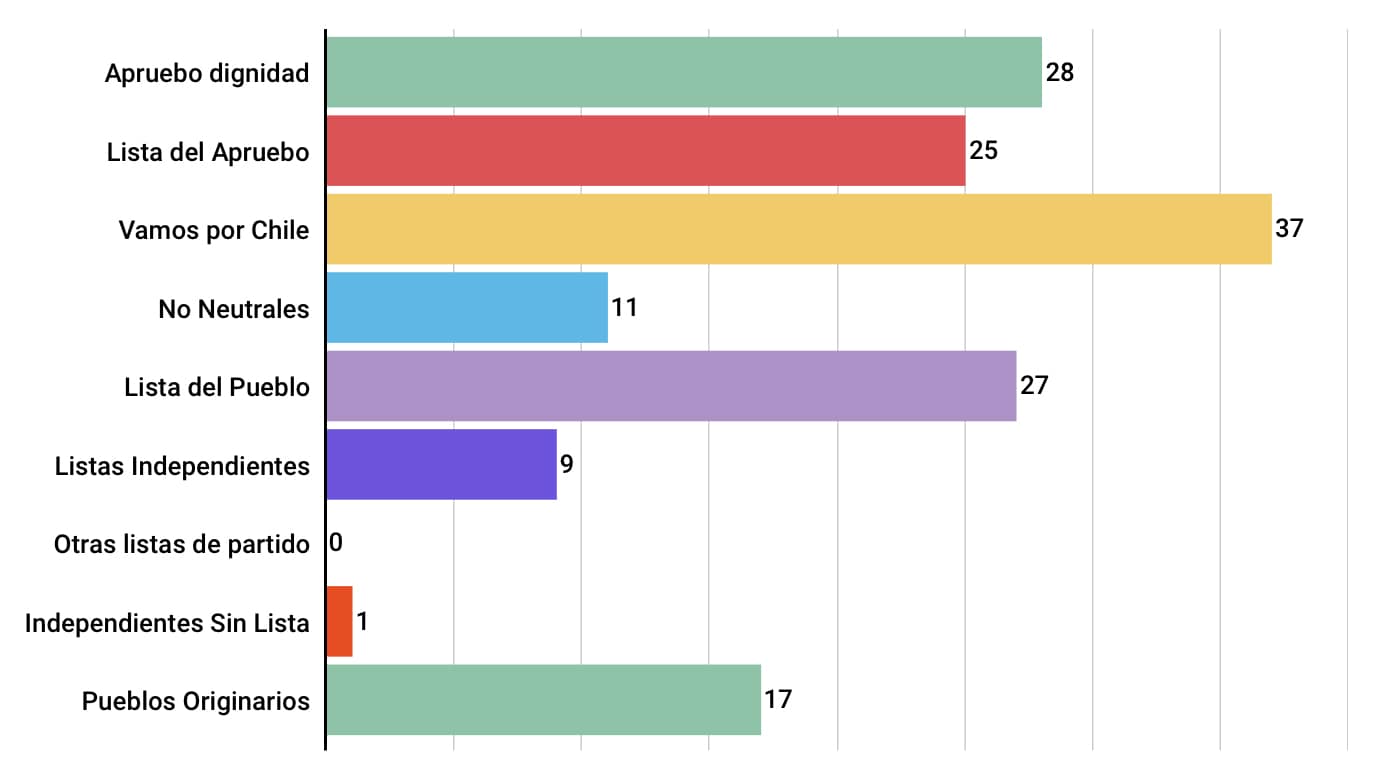
b) Distribución de fuerzas políticas por escaños
La Lista del Pueblo y los Independientes por una Constitución se convirtieron en la gran sorpresa.
c) La votación y escaños para Pueblos Originarios
La nueva Constitución también será escrita por los 17 representantes de los grupos indígenas de Chile.
Diarios de una elección
- Se consolidan los independientes como primera fuerza, al obtener 88 escaños de los 155 que albergará el Palacio Pereira cuando se inicie la redacción de la nueva Constitución.
- Esta es la primera Convención Constitucional en el mundo que cuenta con paridad de género.
- Del total de 17 escaños reservados para representantes de los pueblos originarios, la elección estuvo marcada por candidatos ligados al conflicto en la macrozona sur.
- La primera sesión de la Convención Constitucional se realizará en junio, a pesar de que aún no hay una fecha establecida.
Qué dice el mundo económico internacional
- “Ninguna de las listas controlará más del 25% de los 155 escaños. Los grupos independientes y de izquierda ocuparán más del 70% de los escaños, pero existe una heterogeneidad significativa entre ellos”, (Goldman Sachs).
- “El texto real de la Constitución tardará varios meses en presentarse, lo que puede llevar a los operadores a adoptar un enfoque más cauteloso sobre los activos chilenos después de que la reacción instintiva pierda fuerza”, (Agencia Bloomberg).
- “El castigo a la política tradicional, la heterogeneidad de los independientes y la extrema izquierda sobre los moderados sugieren un régimen de mayor incertidumbre en el futuro”, (JP Morgan).
- “Los mercados no quedaron deslumbrados con el resultado, ya que la coalición oficialista de centroderecha no logró obtener un tercio de los escaños en el organismo que redactará la Carta Magna. Las propuestas requerirán una mayoría de dos tercios para ser incluidas (…) La convención constituyente, que se formará estará fragmentada, indicio de que en algunas áreas se requerirá bastante negociación”, (BNamericas).
Para mantener en el radar:
1. La Lista del Pueblo
- El pacto se convirtió en la cuarta fuerza política en la Convención Constitucional con 27 escaños, es decir 17,4%.
- Se configuraron en el marco de las protestas sociales del estallido social de octubre de 2019. Se declaran de izquierda, pero distantes de los partidos políticos, incluso del PC y el Frente Amplio, con quienes no estuvieron dispuestos a asociarse durante la campaña.
- “Somos quienes hemos luchado toda la historia por obtener dignidad y justicia. Somos quienes hemos vivido y crecido en la inequidad y la desigualdad, somos quienes nos levantamos un 18 de Octubre para decir basta”, se lee en su página web.
- Para ser parte de la Lista del Pueblo sus candidatos debían cumplir ciertas exigencias, tales como no haber estado involucrados en fraudes, violencia de género, maltrato y abuso sexual. Entre ellos hay abogados, historiadores, ingenieros, activistas ambientales.
- Dentro de sus figuras más mediáticas se encuentra Giovanna Grandon, más conocida como la ‘Tía Pikachú’, quien se hizo viral tras protestar con el disfraz del personaje de la serie japonesa en medio del estallido social. También está Constanza San Juan, conocida por ser la vocera de la Asamblea por el Agua de Guasco Alto y participar en el diseño y ejecución de la estrategia comunitaria, comunicacional y jurídica que consiguió el fallo de clausura del proyecto minero Pascua Lama. Mientras que María Magdalena Rivera, quien es la defensora de los detenidos de la “primera línea” y quien interpuso una querella en contra del presidente Sebastián Piñera por delitos de lesa humanidad en noviembre de 2019, también obtuvo un escaño por esta lista.
- Tras la elección, sus integrantes han dicho que quieren conformarse como una bancada independiente en la Convención Constitucional.
2. Independientes No Neutrales
- Se trata de una agrupación de centroizquierda no militante que se define como “un grupo diverso, transversal y comprometido con la actividad pública”.
- Reconocen que trabajan “en organizaciones de la sociedad civil y la academia; desde la cultura, las ciencias, el urbanismo, las comunicaciones y los demás quehaceres sociales”.
- Bajo su alero lograron elegir al ex director del Hogar de Cristo y actualmente presidente Ejecutivo de América Solidaria, Benito Baranda, el no militante con mayor votación, con 46.637 sufragios.
- La lista se quedó con 11 escaños en la Convención, es decir el 7%.
3. La nueva configuración municipal
- Los resultados de las elecciones muncipales también pusieron en evidencia la nueva configuración del mapa político chileno. Al analizar y comparar la data -respecto de los últimos comicios celebrados en 2016- existe una fuerte baja para Chile Vamos y lo mismo ocurre con los partidos de la ex Concertación.
- La UDI obtuvo 33 alcaldías, 20 menos que en 2016 y Renovación Nacional se quedó sólo con 32, es decir 15 menos de las que obtuvo durante la elección pasada.
- Para el El PPD las cosas tampoco han estado fáciles luego de reconocer que pasarán de 26 a 16 alcaldías menos que en 2016. Mientras, el Partido Socialista, perdió tres muncipios.
- Los resultados de las votaciones en comunas emblemáticas, como Viña del Mar, Ñuñoa y Maipú, demostraron lo impredecible que se ha vuelto el tablero político. El foco principal se instaló en Santiago, donde la militante del Partido Comunista y concejal, Iraci Hassler se impuso con el 39% en una contienda histórica.
- En el caso de Recoleta, el alcalde del PC, Daniel Jadue asumirá su tercer período consecutivo tras obtener el 64% de los votos.
- “Llama la atención los malos resultados, no sólo de la centroderecha sino de todos los políticos tradicionales. Es un voto de castigo super fuerte. Han habido abusos, escándalos, aprovechamientos. Y si no lo reconocemos, porque no sucede nada a nivel judicial, la ciudadanía lo castiga», dijo Evelyn Matthei quien logró conservar la comuna de Providencia.
4. Los Gobernadores en pausa
- Los resultados de las elecciones a Gobernadores permitieron que sólo tres candidatos se impusieran en el cargo, de un total de 16, tras obtener más del 40% de los votos.
- En Valparaíso el triunfo fue del Frente Amplio con la elección de Rodrigo Mundaca, quien atrajo el 43% de las preferencias.
- En el sur, los candidatos de Unidad Constituyente fueron los elegidos. Andrea Macías, la única mujer hasta el momento elegida en el cargo obtuvo el 48,68% de los votos por Aysén. Mientras que Jorge Flies logró convertirse en Gobernador de Magallanes con el 42,12% de los votos.
- Para el próximo 13 de junio está fijada la fecha de la segunda vuelta electoral para elegir a los nuevos Gobernadores restantes.